Hello! Welcome to my little big world, full of adventure! And welcome to Canada –since so many Americans check out my website.
I’ll start with my picture books, which I’m most known for. Then let you in on my very rare approaches to the medium – approaches lost to history. And my unusual additions. And why it matters.
Each of my children’s picture books have different themes and moods. I do my best to “enlarge and enhance man’s mental and moral nature.” This is done by making entertaining books where the themes are engaging, the mood is intriguing, the story is exciting, the characters are interesting, and the artwork suits it all.
Parents have informed me that their children, as young as 3 and a half have memorized a number of my books, especially Big Electric Cat and The Ugg and the Drip, (which are actually written for older children, up to eight years of age). When I was in hospital, for an operation, one of my nurses recognized my name and showed me a video of her three year old son “reading” (reciting from memory before he could actually read) the pages of Big Electric Cat. I witnessed this myself with one of my nieces, who couldn’t yet read, but had both books memorized. At the age of three, she recited The Ugg and the Drip to me, with great emphasis on the dialogue, all on her own without prompting while playing with her toy cars.
With another favourite, The Boy from the Sun, I’ve heard two accounts from parents of children who at only 18 months old, laid the book on the floor, opened it up to the pages with the double-spread imagery of forests and tried to climb into them. I continue to get feedback, especially when selling my books at markets. And now that my books have been out there for a while, I’m getting feedback from young people; teenagers and 20-somethings, telling me how much they loved my books as children. And I mean “loved.” Their parents told me how they’ve read them hundreds of times to their children. The feedback has been amazing. My favourite bit of feedback was when a young Goth girl, all in black, pierced, tattooed, and wearing black lipstick, strode up to my table at a market and said, without smiling, “Duncan. I love your books. Thank you for making my childhood brighter.”
To create great books I avoid being didactic. I refuse to produce government pamphlets or pill books, the kind of books where authors are more interested in wagging their fingers at children or expecting children to join them in a mission to save the world rather than creating entertaining books worth reading. Creating delight for children is much more important than an author’s virtue signalling. History is replete with instances where society improved when children had access to books they actually wanted to read.
I like to alter the stylistic treatment of my books. I’m a big fan of variety. And it’s a real challenge to take on different mediums. Most of my picture books are in watercolour, but I also use acrylics and oil. And I hope to do some in pencil. (That’s “graphite” for the snobs.)
This is also true with my non-illustrative work, my Aaaaaawwwwt! as British art critic Waldemar Januszczak would say. I flit around from portraits, to surreal paintings of fish or other creatures, to figurative works in strange landscapes, and on to big themed classical style paintings that are a few meters long. Like my picture books, because themes interest me more than aesthetics, I’m not committed to a particular aesthetic approach. I work with themes sprouting from our human commonalities, whatever it is that Mother Nature (Evolution) has planned for us. And to make these themes accessible to the viewer, the results should be something engaging and worthy of rumination. A good way to start is to employ a combination of the four perennial social functions of art. I expand on this a bit, below.
My animated shorts and little docs: YOUTUBE
Art on the Edge, Articles: HERE
News and Essays: HERE

One result of my approach is that you’re unlikely to see my work in a typical private gallery. Here in Thunder Bay, we no longer have any private galleries. I do have shows in public galleries of which we have two. I’m quite happy showing my work in coffee shops, restaurants, lobbies, etc. And I do have the occasional show I put on myself. I had a little gallery/studio with a storefront for three years before I shut it down due to Covid. It was great having the extra space to work in and the opportunity to interact with the public.
In much of my work I attempt to mix the best properties of High and Low Art (Popular Art). This makes me a Perennialist. I employ the four primary historical functions of art (and all their many sub-functions) that are perennial to human nature. These four functions have been employed by our ancestors for thousands of years in all cultures the world over, which continue to operate today, primarily in popular and tribal cultures. Each of the four functions have many sub-functions. Knowing what these functions are and how they operate gives me confidence in my choices of approach, dramatically expands the richness of a good idea when I get one, and enlarges my understanding of human nature, directing me to endless sources of subject matter. Don’t by into the nonsense that Classical Art is old fashioned, stale, conservative or out of fashion. That’s silly. Does a tree become old fashioned? Or stale? Or conservative or out of fashion? Classicism is a nature based philosophy. It is the study of what you are and what everything else is in the universe is, which… is… endless.

My favourite mediums, in order, are watercolour, graphite, oil, acrylics, and now – more rarely: photography. Watercolour is so much fun because its results are sometimes unpredictable and can lead to amazing accidents. For figure drawing sessions, using watercolour can end in disaster very quickly, but when it works– Wow! It’s almost as if a heavenly muse is tapping my head. And sometimes watercolour likes to do its own magical thing. It’s all about knowing the tools, the paper – being familiar with everything involved. Watercolour teaches you how to paint. Painting in oil isn’t always easy, but it is by comparison to watercolours. (This is all personal preference, of course.) Both watercolour and oils allow for glazing, which… again… Wow! – when it works, you feel like a master artist.

Working in graphite (“pencil” doesn’t sound fancy enough) is very direct. Nothing bleeds, strays, or mixes unless you want it to. Graphite is a great way to have total control. And it’s the best way to plan larger works.

Oils have can have more intensity or murkiness, boldness, texture, contrast, etc. Oils are incredibly versatile, but require a lot of practice to get right. And if you treat oil like watercolour – thinning and letting the oils bleed, you can get some of the same watercolour effects. But oil is stinky, messy (gets freakin’ everywhere) and is heavy (elderly artists find this troubling), and often problematic for your health if you don’t have a big studio and can’t open the windows in winter. I don’t have a big studio, so being a neat freak with oils becomes important.

In the above landscape, Beaver Mountain, the paint gets thicker from top to bottom. Below is an oil painting for the children’s picture book, Lara Wood. Lots of glazing and dry-brush was involved. If you look closely you can see a wolf following Lara.

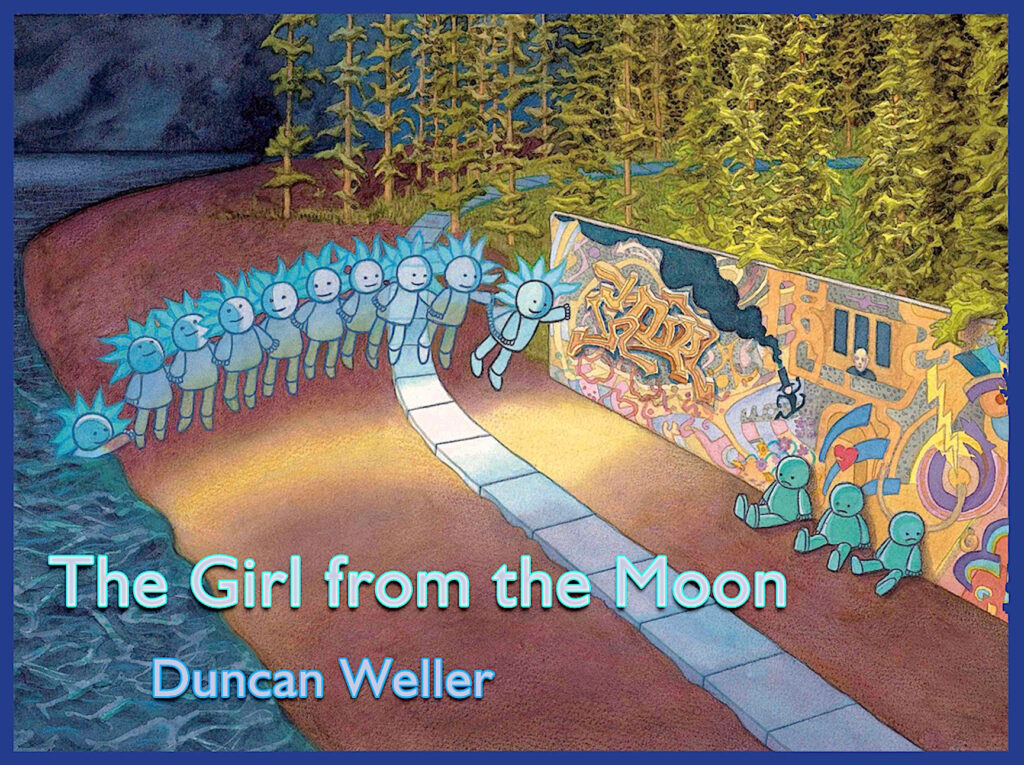
A number of study drawings were required for Lara Wood, but I didn’t plan it out beforehand as much as I should have. I invented without reference and it cost me a lot of time. Because illustrations require narrative detail where allegory and symbolism might be used, for example, the better planned out the illustrations are ahead of time, the better the results. One day I’ll complete the picture book, but in the meantime I’ve developed the story into a fantasy drama for adults.  Illustration for an upcoming children’s picture book, The Girl from the Moon. Watercolour and ink.

The illustration is for The Girl from the Moon is primarily watercolour with a bit of ink work for the path and the little characters. The book will be a companion piece to The Boy from the Sun (winner of a couple national awards back in 2007). I love the concept for this story, but it’s so grand I may have to settle for a truncated version just to get it printed before I die.
The scene of a Beacon Hill beach-front, sprinkled with logs and sticks, is pure watercolour. It was a delight to paint and got so many positive reactions that I could have sold it a hundred times over. Instead I gave it to friends I made in Holland who let me stay with them when a volcano went off in Iceland and nearly all flights across the Atlantic were cancelled.
Portraits! Again, I haven’t chosen one style in which to do things. I love the approaches and techniques of Rembrandt, Wyeth, Freud, Nerdrum, Varley and too many more to list, including a roster of black American and Canadian portrait artists who have broken into the art scene in the last twenty years.

I used to work primarily from photographs to do my portraits, but in the last few years I’m drawing and painting from life. With my figure drawings, my favourites are always those drawn from life. The focus and immediacy required to capture, not only the likeness, but the spirit of the person in a live drawing comes with a lot of practice, and likely talent. (Yes, it’s possible that there are some things you have to be born with.) With all my hundreds of figure drawings I can tell immediately which ones were done from life and which ones from a photo. And I remember the “feeling.” This is hard to explain, but when I was young, whenever I had this “feeling” (like sitting in Heaven) I knew when a drawing would be great – before I drew it. It’s as if my brain was “wired” for this stuff. That “feeling” isn’t there any more, but I know when and where it should be. Once, and very rarely, in a blue moon, it’ll come back to me and it’ll thrill me, but because I want it so badly to come back, it quickly goes away. It’s as if the “talent” is being shy to reveal itself – as if there’s another person inside me who is happy to observe what I’m doing, but no longer needs to encourage me or participate.
My favourite painting is usually my most recent.

For a themed series I’m doing portraits of children posing in a background that they have painted themselves.

Lara Wood makes her way through a dying forest. A wizard has put a curse on the land and Lara is seeking him out to have words with him. Here, a wolf is trailing her and Lara suspects the wolf has its own mission.
The illustration below is from the GG and Schwartz Award winning book, The Boy from the Sun. (Margaret Atwood was on the jury for the Governor General’s Award that year!) The essential meaning behind the book is, ultimately: choose your own path. However! It’s not that simple. There’s a lot more to this “simple” or “basic” book for children. Allegory is fantastic when it works, and I think it works here. Parents have told me that their children have tried to climb into it. Parents have described how their children, at about 16 months of age, have opened the book, laid it out on the floor and tried to climb into the pages. And children who’ve grown up with my book have told me it’s their favourite children’s book. So, that’s… encouraging.
